
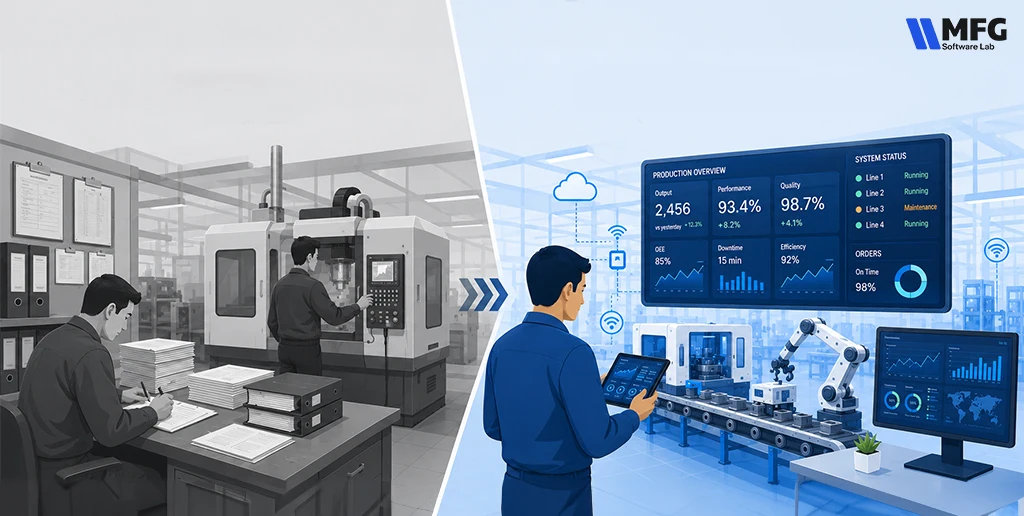
 Digital Transformation
Digital Transformation in Manufacturing: Benefits, Examples & Implementation Guide


When you read ‘digital transformation in manufacturing,’ you might picture automated factories, robots on production lines, or investing millions in an ERP overhaul. We get it. The buzzword feels overwhelming, but the reality is far more practical.
Simply put, digital transformation in manufacturing means improving your factory operations using digital tools and data.
That’s the core idea driving a market projected to reach USD 440 billion.
If you work in the manufacturing sector, going digital can begin with installing IoT sensors to monitor a machine’s health. Another example is using a dashboard that displays downtime, production output, and machine performance in one place. In other words, this transformation often starts with small, practical improvements rather than large-scale changes.
In this blog, we’ll explain this concept through practical examples. Consider it your guide to the benefits, challenges, real-world examples, and implementation of digital transformation in the manufacturing industry.
What is Digital Transformation in Manufacturing
Digital transformation in the manufacturing industry means using technologies like AI, IoT, cloud platforms, and software to improve how a factory operates.
But very few experts will tell you that it isn’t about automating your plant overnight. You don’t need to replace every machine or go all AI-centric everywhere.
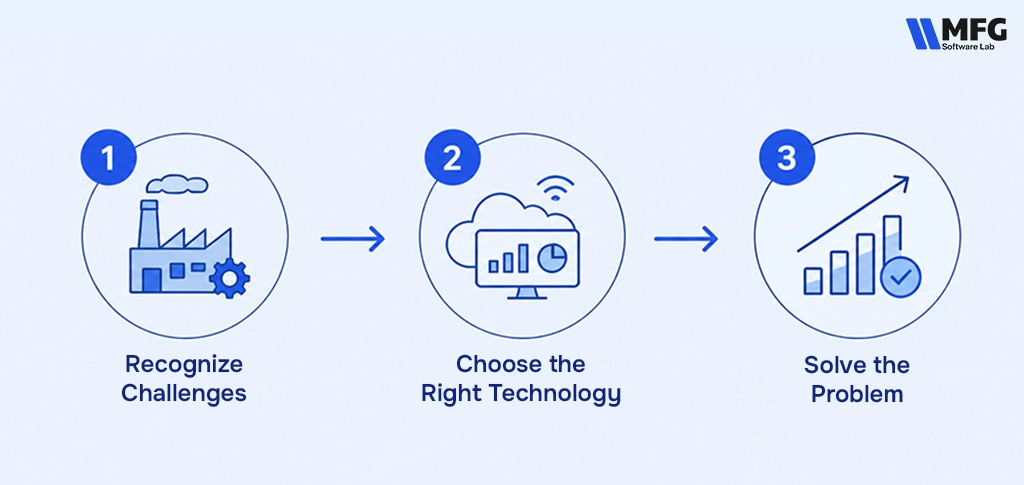
Practical digital transformation means:
- Recognizing current manufacturing challenges
- Identifying what you need to transform
- Choosing the right technologies
- Applying them to solve current problems
As per Mordor Intelligence’s report, the top two drivers of this transformation are IoT platforms and Cloud-native MES.
Now, we didn’t just state these drivers to include some fancy names. If you look closer, you can tie them to what they solve:
- IoT platforms help cut production downtime
- MES (Manufacturing Execution System) enables multi-site planning
Did you observe the common thread?
Neither solution focuses on big, disruptive factory overhauls. They solve real operational challenges. That’s digital transformation in manufacturing. It solves problems one solution at a time.
Digitization vs Digitalization vs Digital Transformation
Before moving on, it’s essential to differentiate the three interchangeable terms – digitization, digitalization, and digital transformation. Because if you’re a manufacturer, you’ll probably come across these terms and think, “Does the IT guy mean this or that?”
Here’s a table to keep handy:
| Aspect | Digitization | Digitalization | Digital Transformation |
| Definition | Converting physical information into digital formats. | Using digital technologies to improve existing business processes. | Reimagining manufacturing operations by integrating digital technologies across the organization. |
| Primary Goal | Eliminate paper-based records. | Increase efficiency and productivity. | Create a smarter, more connected, and data-driven factory. |
| Scope | Individual tasks or documents. | Specific workflows or departments. | Entire plant, business processes, and organizational strategy. |
| Business Impact | Easier record keeping and data accessibility. | Better operational efficiency and fewer manual errors. | Improved agility, profitability, competitiveness, and long-term growth. |
The three interchangeable terms are progressions rather than separate initiatives. You start by digitizing records, then move on to connected dashboards, and finally integrate technologies. So, on the whole, digital transformation in the manufacturing sector is quite beneficial if you plan smart.
The Benefits of Digital Transformation in Manufacturing
Digital transformation (DX) goes hand in hand with smart manufacturing. You use tools and tech to connect production, inventory, maintenance, and quality processes across your plant.
In fact, 92% of manufacturers believe that smart manufacturing can help them stay competitive.
So, if you feel a factory can overlook digital transformation even today, it might be time to reconsider. Here’s how DX solves day-to-day operational challenges:
- Higher manufacturing efficiency: There’s a reduction in human errors and downtime
- Greater operational agility: Easily accessible data and predictive analytics lead to quick decisions
- Safer factory operations: Predictive maintenance, automatic monitoring, and AR/VR-based training improve safety
- Long-term cost savings: Data-driven insights, sensors, and automation reduce labor, downtime, and logistics costs
- One step towards sustainability: Tools track emissions, wastage, and other parameters, facilitating sustainable practices
Ultimately, digital transformation is about building a factory that’s more efficient, connected, and prepared for future challenges.
The Challenges of Digital Transformation in Manufacturing
Digital transformation might sound straightforward on paper. In reality, every manufacturing project comes with its own set of challenges.
Sometimes, it’s easy to assume that an IT overhaul or connecting ERP software to MES systems can guarantee meaningful change. But DX isn’t as straightforward. Before proceeding, you should be aware of these challenges:
- Existing legacy systems: Outdated software systems or hardware can hinder the pace of DX adoption. You need to modernize legacy systems before scaling your DX initiatives
- Fragmented and disparate data: In most factories, data is either siloed, unusable, or inaccessible. So, before planning DX, you need to consider proper data hygiene
- Workforce adoption: Limited digital skills, resistance to change, and lack of project ownership can slow down adoption
- Initial investment: While many initiatives can begin on a smaller scale, larger projects can require significant upfront investment in software, infrastructure, and training
- Security concerns: DX requires new connectivity points for sensors, cloud APIs, IoT gateways, and other systems. Some manufacturers postpone this activity because of cybersecurity and data privacy concerns
Regardless of these challenges, you can always plan and overcome most or even all of them. But first, you need to identify why you need DX. Once you know what you’re trying to improve, these challenges become much easier to handle.
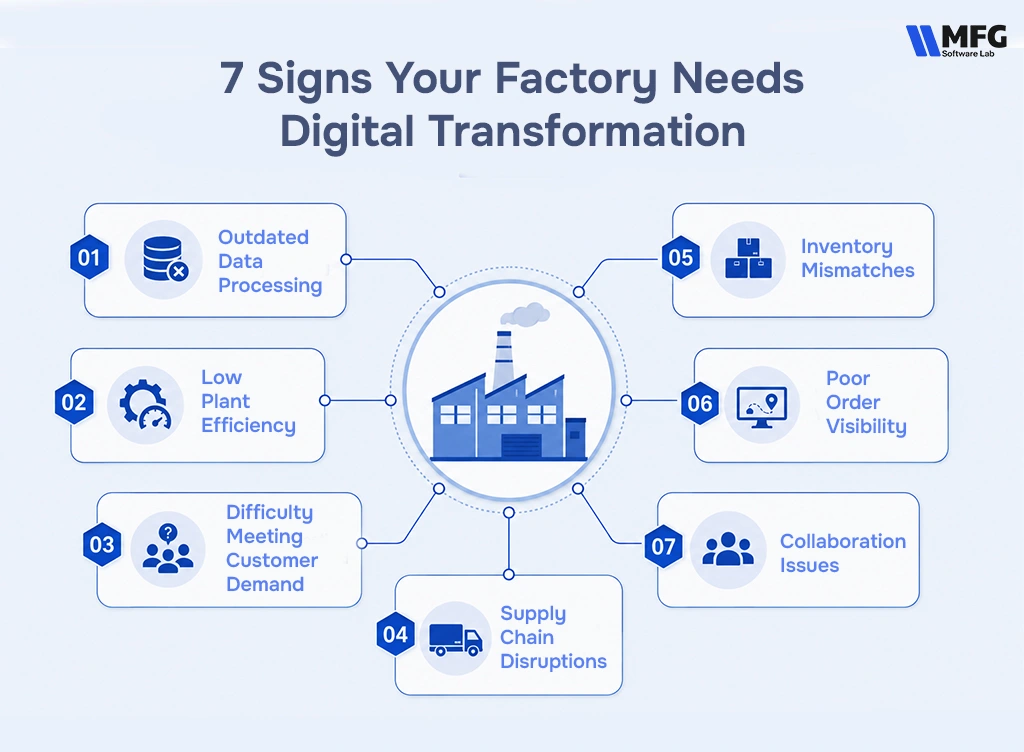
7 Signs Your Factory Needs Digital Transformation
By now, you know manufacturing businesses are taking digital transformation seriously. On the same lines, we found two interesting stats in a Deloitte Insights survey of manufacturing executives:
- 49% of respondents report operational benefits as the primary value
- 44% of respondents cite financial advantages as the core value
So, the positive outlook towards digital transformation in manufacturing is clear. Now, it’s time to see whether your plant needs to plan this initiative. If you identify these seven indicators, it’s time to move a step ahead.
1. Your Data Processing is Outdated
A recent survey on manufacturing data confidence reveals some startling figures. But we won’t bombard you with too many numbers. Just read this one stat that feels compelling – Only 36% of manufacturers feel they can use their data to make the right business decisions.
The rest lack confidence in how they process and manage their current data. The reasons aren’t surprising.
Many manufacturers manage production data with:
- Paper records
- Excel spreadsheets
- Disconnected software
The result? Duplicate entries, human errors, and a lot of time spent collecting data rather than using it. If this sounds like your plant, it might be time to consider a digital transformation in manufacturing.
A planned DX initiative centralizes data and gives your teams easy, real-time access.
2. Your Plant’s Efficiency Has Taken a Hit
Outdated infrastructure in your factory can reduce efficiency. We know this is cliché, but the numbers tell you something worth considering.
Legacy systems:
- Create data silos
- Halt IoT integration
- Delay decision-making
Such setups can lower the overall equipment effectiveness (OEE) by 35%. So, if you’re facing the following issues, it’s time to consider a smart DX initiative:
- Declining production output
- Frequent machine downtime
- High operational costs
- Frequent quality issues
Now, get one thing straight – digital transformation in manufacturing isn’t a magic wand. Even after you implement an initiative, these issues won’t disappear overnight. However, DX can enable your team to take proactive steps to maintain high productivity.
Note: Data silos are a common buzzword these days. It simply means your data is isolated and incompatible with other systems.
3. Keeping Up with Customer Demand Is Becoming Difficult
Let’s shift our focus from internal operations to customers. Today, customers want:
- Great quality products
- With shorter lead times
- And faster deliveries
- And tailored services
- With quick updates
That’s how times have changed. If you feel quality is the only customer expectation, you are wrong. Keep an eye on your customer complaints. If they rant about late updates (or none), slower deliveries, or a lack of customization, it’s time to plan a digital manufacturing transformation.
DX can connect production planning to inventory and give a better view of your logistics. An order management software can often solve most of these challenges seamlessly.
4. Supply Chain Disruptions Keep Affecting Your Operations
Your production schedules depend a lot on:
- Raw material deliveries
- Inventory levels
- Supplier challenges
Once these get hit, your operations suffer. If you face a similar challenge, it’s time to look into the impact of digital transformation in manufacturing.
With a well-planned DX initiative, you can build a resilient supply chain. How?
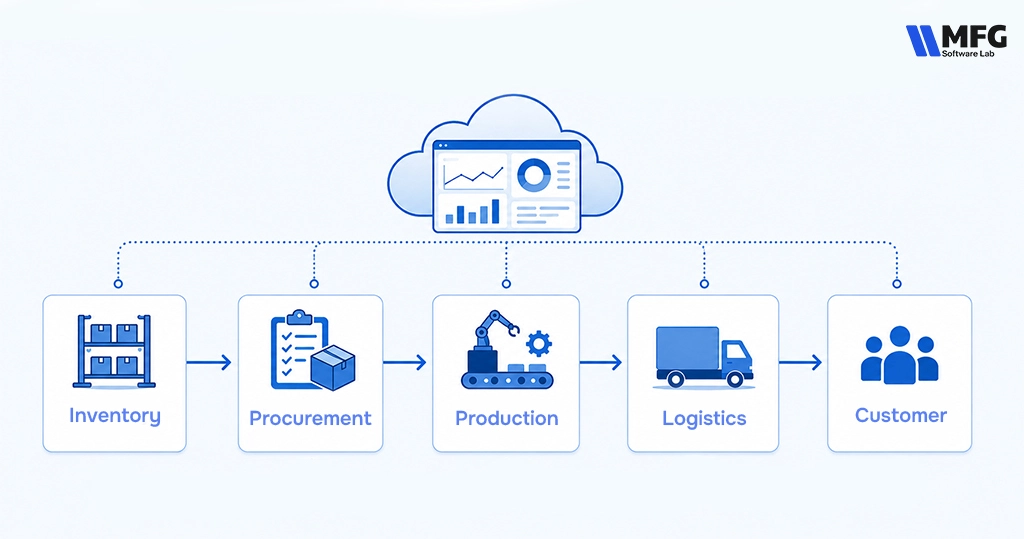
An integrated system can connect inventory, production, procurement, and logistics together. This way, you can:
- Get precise demand forecasting
- Plan inventory before major disruptions
- Respond faster to sudden events
Overall, if your team constantly adjusts production plans, it suggests you should explore the prospect of DX.
5. Inventory Is Constantly Out of Sync
If you use manual tracking methods and disconnected systems, inventory sync issues are quite common.
Think about it. You use separate Excel spreadsheets for different items. The chances of data entry errors are high. There’s different software for accounting, production, and procurement, making data silos more likely.
If your team can’t track work in progress (WIP), you’ll face reconciliation problems. Custom DX projects with cloud technologies can solve these challenges. So, if you notice your team handling many inventory mismatches, it might be time to consider digital transformation at your plant.
Note: This case study on improving inventory visibility shows how DX can be a valuable investment.
6. Order Tracking Lacks Visibility
Answer these questions:
- Do you still use phone calls or emails to check order updates?
- Does your team need to contact other departments before speaking with customers?
If the answers were yes, you’re dealing with slow internal communication and poor visibility. With a connected order management system, you can create a unified view of:
- Production
- Inventory
- Logistics
- Orders
So, it becomes easier to track order progress and customer queries, and to check for delays before they impact your deliveries.
Bottom line: Check whether your team spends more time tracking orders than fulfilling them. That’s a clear sign your factory needs a suitable initiative.
7. Your Team Faces Collaboration Issues
Operating a manufacturing business means managing different departments. Importantly, all of them need to collaborate seamlessly with each other.
But real-world operations aren’t ideal, right? And if you agree, you’re not alone.
97% of manufacturers face collaboration issues that affect productivity and hamper their competitiveness. That’s an overwhelming majority of manufacturers.
However, with the rise of digital transformation in manufacturing, you can reduce these collaboration issues. DX creates a connected ecosystem that helps overcome these challenges. So, if you notice your employees chasing updates or working on disconnected systems, it’s time to ditch the old ways.
Digital Transformation Examples in Manufacturing
You might now be wondering, “This sounds good in theory. But are manufacturers actually doing this?”
In a word, yes. Here are four real-world examples.
Pringles: Successful Use of Big Data and AI
The popular potato-chip brand is one of the prime examples of digital transformation in manufacturing. Notably, the story is quite interesting.
Using Siemens’ Digital Twin approach, Pringles increased its line performance by 10%. Instead of overhauling the production line, they focused on using existing production data more intelligently.
They used sensors and an edge-based AI model to calculate the dough recipe for their product in real time. This way, operators could make the necessary changes based on instant inputs from the artificial intelligence model.
Nike: Building Customer Relationship with DX
This prominent sports brand is one of the excellent examples of marketing, quality assurance, and, of course, digital transformation.
With apps like Nike Run Club and Nike Training Club, the American sports equipment manufacturer encourages its audience to stay connected without hassle. But these apps don’t just exist to maintain customer relations. They are a great source of valuable data.
Nike analyzes this data to develop new products based on customer preference. The customer insights collected through these platforms influence product design, inventory planning, and manufacturing decisions.
If you thought digital transformation in manufacturing was only about optimizing factory operations, this example proves otherwise.
This example proves that you can use DX to enhance your customer-facing side too.
Sanning Chemical: Boosting Safety and Plant Efficiency
China’s chemical company, Sanning, shows how digital transformation can upgrade a challenging work environment. For DX, they worked with Schneider Electric’s EcoStruxure upgrade.
By connecting equipment and analyzing operational data in real time, Sanning improved maintenance efficiency, reduced energy consumption by 5%, and created a safer operating environment.
In addition, Sanning could facilitate remote operator training with these digital solutions. Examples like this show that digital transformation initiatives should be tailored to each manufacturer’s operational needs.
Texas-based Solar Equipment Provider: Automating Site Assessment with Project Sunroof
One of our client projects offers another practical example. A solar equipment provider in Texas relied on manual site assessment methods to evaluate project sites, generate customer proposals, and plan their installations.
Calculating estimates was a hassle, and proposal creation was dependent on internal teams. The main issue? Slow response times and customer onboarding.
During the digital transformation, the provider used Google’s Project Sunroof to reduce dependence on in-person visits. The solution reduced operational costs by 57% while helping the company respond to customers much faster.
The result shows that digital transformation can improve not only internal efficiency but also customer acquisition and business growth. You can explore this case study and understand how DX can indirectly support manufacturing sales growth.
Prominent Technologies to Consider for a Successful Digital Transformation
To implement DX, you need basic knowledge of the tech driving it. Don’t worry, there’s no need to be a subject-matter expert in IT. Basic know-how about the role of each technology can help you have more informed discussions with your technology partners.
The table below shows the main role of each tech in driving digital transformation in manufacturing.
| Technology | How It Supports Digital Transformation |
| Industrial Internet of Things (IIoT) | Connects machines, sensors, and equipment to collect real-time production data. Enables predictive maintenance, equipment monitoring, and improved operational visibility. |
| Artificial Intelligence (AI) & Machine Learning (ML) | Analyzes manufacturing data to predict equipment failures, optimize production schedules, detect quality issues, and improve decision-making. |
| Manufacturing Execution System (MES) | Tracks and manages production activities on the shop floor. Provides real-time visibility into production, quality, and work in progress (WIP). |
| Enterprise Resource Planning (ERP) | Integrates and standardizes core business functions such as procurement, inventory, finance, production planning, and order management into a single system. |
| Cloud Computing | Enables centralized access to manufacturing data across multiple locations and scalable infrastructure without relying entirely on on-premises systems. |
| Digital Twins | Creates a virtual representation of machines, production lines, or entire factories to simulate performance, identify bottlenecks, and test improvements before implementation. |
| Advanced Data Analytics & Business Intelligence (BI) | Converts production and operational data into dashboards and reports that support faster, data-driven decisions. |
| Robotic Process Automation (RPA) | Automates repetitive administrative tasks such as invoice processing, purchase orders, inventory updates, and reporting, reducing manual effort and errors. |
| Collaborative Robots (Cobots) | Assist human operators with repetitive or physically demanding tasks while improving productivity and workplace safety. |
| Augmented Reality (AR) & Virtual Reality (VR) | Supports employee training, remote maintenance assistance, equipment troubleshooting, and immersive work instructions. |
| Cybersecurity Solutions | Protects connected manufacturing systems against cyberattacks, unauthorized access, and data breaches. |
| Warehouse Management System (WMS) | Improves inventory accuracy, warehouse operations, stock movement, and order fulfillment through real-time tracking and automation. |
Remember, a successful digital transformation doesn’t require implementing every technology on this list. The right combination depends on your goals, infrastructure, budget, and long-term priorities.
How to Implement Digital Transformation in Your Factory (The Steps)
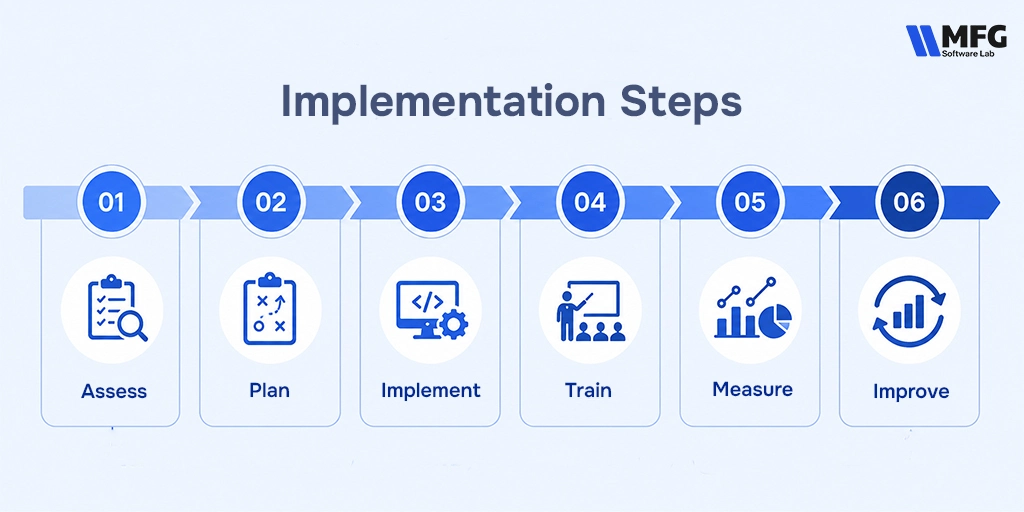
If you believe digital transformation can benefit your factory, it’s time to understand how to move on. This section aims at practical implementation. Explore each step you need to take to improve the chances of a successful DX project.
1. Identify Your Goals and Operational Challenges
Start by identifying what you need to fix first:
- Downtime
- Poor inventory visibility
- Quality issues
- Production delays
You shouldn’t follow trends. This means it’s okay not to invest in AI if it doesn’t fit your factory operations or budget. Sometimes, developing a connected system with robust APIs can prove more beneficial than costly LLM integrations.
So, know your goals. Talk to your production managers, supervisors, and machine operators. And discuss the existing challenges with your IT partner.
2. Assess Your Existing Infrastructure
We suggest manufacturers walk and observe in their factory. Spend time on the shop floor. Observe how work happens before deciding what needs to change. This step helps them understand what needs an overhaul or modification.
So, if you’re in the manufacturing sector, evaluate your:
- Machinery
- Software
- Network infra
- Data quality
Check legacy systems that need modernization. Talk to your employees and gather their feedback. For all you know, most of them might be typing each raw material entry in an Excel sheet!
3. Choose the Right Technologies
Remember: operational priorities should always take precedence over market trends.
You should choose technologies that suit your workflow. Even better? Discuss custom manufacturing projects with your IT vendor. These can deliver high ROI by solving your specific problems.
In this step, your goal should be to solve challenges rather than implement tech that just feels ‘cutting-edge.’
For example, an MES may improve shop-floor visibility, while IoT sensors may be better suited to predictive maintenance.
4. Start with a Pilot Project
Digital transformation in manufacturing can be incremental. This means you don’t need to transform your entire factory at once.
Start with a single production line or a department or a process.
Then, measure the results. Get feedback from your workforce. If needed, refine your approach before scaling the DX initiative across your organization. A successful pilot also builds confidence across the organization before a larger rollout.
5. Train Employees and Manage Change
Before forcing your employees to use new software, train them. You should involve them in the implementation process.
We encourage brainstorming sessions with our clients and their team. This way, it becomes easier to understand the absence of skills and suggest suitable courses.
Remember: Resistance to change is natural. Your job is to make change worth their effort.
6. Monitor Performance and Focus on Refinement
Lastly, you should get this fact straight – digital transformation in manufacturing isn’t fully a one-time project. It’s an ongoing process of adding new capabilities, refining existing systems, or retiring processes that don’t add value.
So, you need fixed KPIs to measure performance. This way, it becomes easier to identify opportunities for improvement and transformation. (And if you’re wondering which KPIs to decide, fret not. The next section sheds light on those indicators).
How to Measure the ROI of Manufacturing Digital Transformation
ROI calculations can easily become a topic in their own right. For this guide, we’ll keep the explanation simple and practical.
- First, calculate how much you spend
- Then, evaluate how much you gain
- At last, find out your net ROI
This table simplifies the concept:
| Parameter | Inclusions |
| Investment | Software development, implementation, training, maintenance, operational, hardware costs |
| Benefits | Reduced downtime, high efficiency, increased sales, better product quality |
| ROI | Profit or loss after considering both investments and benefits |
Now, to measure benefits quantitatively, you need to monitor these KPIs:
- Overall equipment effectiveness (OEE)
- Machine downtime
- Production throughput
- Inventory accuracy
- Defect and scrap rate
- Employee productivity
Track these KPIs consistently instead of treating them as one-time checks. Together, they provide a practical picture of whether your digital transformation initiatives are paying off.
Summing Up
Digital transformation in manufacturing is a long-term process of using the right technologies to enhance your factory operations. To implement it effectively, start by identifying the operational challenges you want to solve, then choose technologies that address them.
The majority of manufacturers are already investing in IoT, AI, machine learning, and AR/VR (for employee training) initiatives. However, successful digital transformation initiatives don’t always need to be broad or involve the latest technologies.
A custom web portal, a connected MES system, or even dedicated mobile apps collecting relevant customer data (with consent) can boost your manufacturing operations. Start with a pilot project and keep tracking relevant KPIs to make informed decisions as your initiatives evolve.
If you’re planning your digital transformation journey, partnering with a manufacturing-focused software development company can help you implement solutions tailored to your operations.
